Bild eines Flugzeugs an einem feuchten Tag:
Image of an airplane at a humid day:
Nahezu stehender "Nebel" ("Wattewolken") / Nearly stationary "Fog":

Video "Nebel" ("Fog")
Video "Startendes Flugzeug" (taking off airplane)
Bild fliegender Pelikane:

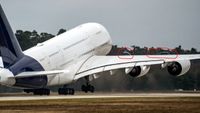
Startender A380 (kein/no Fake ;-)
Hier ein Bild eines Projekts von Wilfried Richter:
Ja Ihr seht richtig, der Propeller "bläst" tatsächlich nach schräg oben!
Das Modell fliegt sehr sicher und auch sehr effizient (ca. 30% weniger Stromverbrauch!)
Die Blau markierten Flächen sollen noch mit Solarzellen belegt werden.
Here an image of a project of Wilfried Richter:
Yes you see correctly, the propeller in fact "blows" up at an angle!
The model flies very safely and very efficiently (approximately 30% less power consumption!)
Areas marked blue will be covered with solar cells.

Hier noch einige Beispiele von "Wirbelschleppen" an Propellern (sichtbar an einem feuchten Tag):
Here are some more examples of 'vortex trails' on propellers (visible on a humid day):
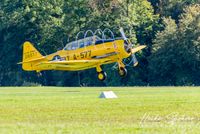
.jpg/picture-200?_=19abb500d20 "North American T6 Texan")
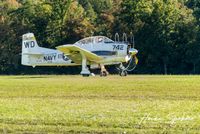
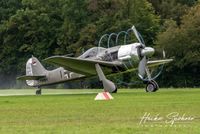
Ich habe einmal ein paar überschlägige Berechnungen durchgeführt:
Die Flugzeuge sind so ca. 9 - 10 m lang.
Der längste sichtbare Wirbel (erstes Bild) hat ca. 6m - zählbar sind 6 Schleifen / 2 (Blattpropeller) = 2m/Umdrehung
bei angenommenen 2000 U/min (~ 33 U/s) Propellerdrehzahl ergeben sich ~65 m/s und das wiederum ca. 240 Km/h "Strahlgeschwindigkeit" (...könnte einigermaßen realistisch sein).
Weiterhin habe ich einmal den (nutzbaren) Propellerdurchmesser mit 2 m angenommen, das ergibt ~ 15 m² x 65 m/s = ~1000 m³
1 m³ Luft hat eine Masse von ca. 1 Kg, also ergibt sich daraus ein Schub von 1000 Kg bzw. 1 t.
Bei einer Abflugmasse von 2,5 t scheint mir auch das als realistisch. (Scheibt mir, wenn ich vollkommen daneben liege ;-)
Auch hier will ich noch einmal erwähnen, dass die hier sichtbaren Randwirbel nichts anderes sind als die Randwirbel an einem Flügel (wenn man in Gedanken einen Propeller immer weiter verlängert, dann "verliert" sich die Drehbewegung und es wird daraus ein Flügel. Demnach lässt sich die oben gemachte Berechnung auch genau so für den Flügel eines Flugzeugs anwenden...
I once did some rough calculations:
The airplanes are about 9 - 10 m long.
The longest visible vortex (first image) is about 6 m - countable are 6 loops / 2 (two-blade propeller) = 2 m per revolution.
Assuming a propeller speed of 2000 rpm (~33 rev/s), this results in ~65 m/s and thus about 240 km/h "jet speed" (...could be reasonably realistic).
Furthermore, I once assumed the (usable) propeller diameter is 2 m, which gives ~15 m² × 65 m/s = ~1000 m³.
1 m³ of air has a mass of about 1 kg, so this results in a thrust of 1000 kg or 1 ton.
With a takeoff weight of 2.5 tons, this also seems realistic to me. (Write to me if I'm completely off ;-)
I would like to mention again here that the vortices visible at the edges are nothing other than the edge vortices on a wing (if you mentally extend a propeller farther and farther, the rotational movement 'dissolves' and it becomes a wing. Accordingly, the calculation made above can also be applied exactly the same way to the wing of an airplane...